Case study
Besòs Tordera - Kubernetes solution for a Besòs river sanitation system
Client
Besòs Tordera
Services
Cloud
Industry
Water
Context
The client CONSORCIO DE BESÒS TORDERA operated 27 sanitation systems in the Besòs river basin without an integrated view of the data generated by each one. Critical information about water quality, hydraulic performance, asset maintenance, and discharge events was spread across more than a dozen heterogeneous and disconnected systems.
Challenge
Fragmented system visibility
None of the solutions communicated with each other, preventing technical staff from having a unified real-time view of system status or making proactive decisions during heavy rainfall events, overflows, or polluting discharges into the river.
Lack of predictive models
The absence of AI-based predictive models that could anticipate, within a 2 to 24-hour horizon, flow arrivals at wastewater treatment plants, overflow risks in the collector network, or the impact of effluents on Besòs water quality.
Lack of a digital twin
The absence of a digital twin capable of simulating alternative operating scenarios to optimize operations in real time.
Solution
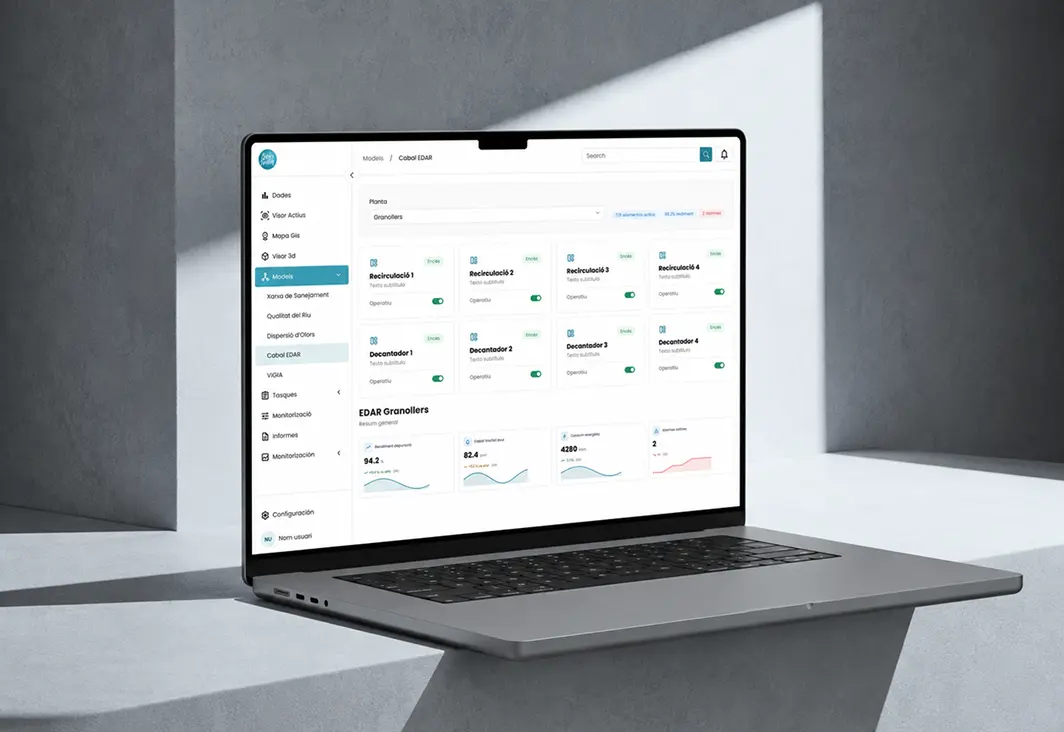
The proposed platform, deployed on Amazon EKS on AWS with high availability across two zones (AZ-A and AZ-B), a data acquisition and integration middleware, and an RDS PostgreSQL database, solves this challenge by centralizing all water-cycle information in a single data lake and exposing it through Kubernetes containers to operators via a management and decision-support platform with real-time monitoring.
Technologies used
On-Premise Clients
End users are located in local on-premise facilities. Their desktop computers or servers connect to the AWS infrastructure through a Customer Gateway, which is the local endpoint of the VPN connection. This device, whether physical or virtual, establishes the encrypted tunnel to AWS.
VPN Tunnel (Site-to-Site VPN)
Communication travels through an encrypted IPSec VPN tunnel between the on-premise Customer Gateway and the Virtual Private Gateway in AWS. This ensures that all traffic between the corporate network and the cloud travels securely and privately, without exposure to the public internet.
Interconnection VPC (Secondary VPC)
Traffic reaches a VPC dedicated to connectivity, where the platform entry components are located. This layer contains:
- Load Balancer: receives incoming requests, distributes them, and applies routing policies.
- Service Mesh: manages communication between microservices, applying security, observability, and traffic control policies, typically implemented with tools such as Istio or AWS App Mesh.
- EKS (Elastic Kubernetes Service): the Kubernetes control plane that orchestrates containers and routes traffic to the worker nodes in the production VPC.
Multi-AZ
The main production VPC is distributed across two availability zones (AZ-A and AZ-B), ensuring high availability and fault tolerance.
Public subnets (AZ-A and AZ-B)
They host NAT Gateways and/or Application Load Balancers that provide controlled internet access and receive external traffic.
EKS Private subnets (AZ-A and AZ-B)
These are the private subnets where Kubernetes worker nodes run with their respective pods (microservices/containers). Each AZ has its own node group with Auto Scaling, enabling horizontal scaling according to demand. Access to RDS PostgreSQL is provided through an RDS Endpoint, which centralizes and controls connections from the EKS pods to the database. The database is never directly exposed to the internet.
DevOps - CI/CD - GitLab continuous integration
The development and continuous delivery process is automated through GitLab as the controller for manifest versions and deployment to AWS. It is supported by Argo CD capabilities to maintain continuous synchronization with the solution in both production and pre-production.
Using the GitOps methodology with Argo CD, GitLab repositories are established as the source of truth for configuring and managing the applications and tools deployed in EKS. This allows the client to configure deployed applications and synchronize them easily without accessing or operating the clusters.
Results
Centralization of operational knowledge
Reduced reporting time and manual effort by providing a single access point to data from all departments.
Data-Driven Decision Making
Transformation of technical management into strategic, data-driven management: integrated dashboards and unified KPIs enable a shift from reaction to planning.
Greater anticipation and resilience
In the face of extreme events, illegal discharges, and industrial spills, supported by predictive analytics and early warning systems.
Cost and energy consumption optimization
Meeting the goal of saving up to 17% of the electricity consumption of wastewater treatment plants, with a direct impact on operating costs.
Compliance with European environmental and regulatory objectives
Automatic traceability of compliance with the Water Framework Directive, the DPH Regulation, and water reuse regulations, with reports generated without manual intervention.
Strengthening institutional transparency
The architecture enables the launch of citizen portals and environmental communication dashboards, consolidating CBT as a benchmark in public water management.
Alignment with European sustainability and digitalization policies
The solution puts the objectives of PERTE Agua and the PRTR into practice, consolidating CBT's leadership in the intelligent management of public water.

SATEC specializes in the development and modernization of containerized solutions in on-premises or cloud environments

Interested in our solution?
Leave us your email and we will get in touch to learn about your needs in detail.